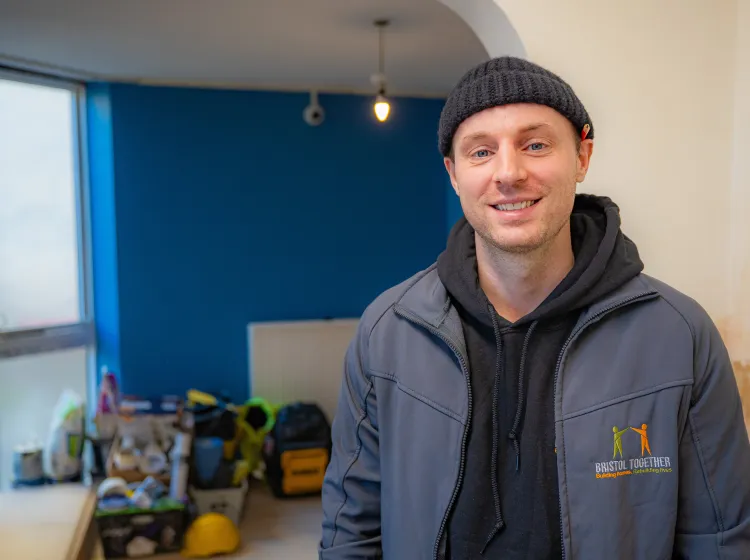
DHI has teamed up with social enterprise Bristol Together on the transformation of our Bath supported housing, generously funded by B&Q Foundation and Screwfix Foundation. We asked Jake Wells, Managing Director of Bristol Together to tell us more about their work – and why partnering with DHI is such a perfect fit.
What is Bristol Together and what do you do?
We’re a social enterprise that helps prison leavers back into employment. Bristol Together was set up to open employment pathways for people leaving prison by delivering high‑quality building projects – homes, cafés, restaurants and more. Alongside that construction work, our social mission is to support people who’ve been through the prison system into stable, meaningful employment.
Tell us a bit about the project your team is working on with DHI.
This project to refurbish the kitchen and bathrooms at Burlington House is a brilliant example of our social mission coming full circle. Not only are we providing employment and training for people with lived experience of the criminal justice system, but the end result benefits people who may have been through similar challenges.
Both organisations’ social missions align perfectly, and that makes the work incredibly meaningful. It’s exactly the kind of project we love to deliver.
What inspired you to focus specifically on supporting prison leavers through construction?
Construction is a natural pathway for many of the people we work with. A lot of them aren’t familiar with, or comfortable in, classroom environments. Learning through practical, hands‑on work can be incredibly empowering. Being on site, making things and seeing progress every day helps build confidence in a way that traditional learning often doesn’t.
How does your work help people rebuild their lives after prison?
Stability is the biggest thing we offer. I’d describe us as a patient employer. We understand the systems people are navigating when they leave prison, and we work with them rather than penalising them for it.
If someone is released on licence and needs an afternoon off to meet their probation officer, that’s fine. If their supported housing arrangement only allows them to work two days a week, we’ll create a part‑time role until they’re ready to move into independent accommodation.
Alongside that, they’re gaining skills, confidence and routine – all of which are essential for rebuilding a life.
What changes do you see in people as they develop their skills and confidence?
The arc of confidence is huge. Some people arrive hesitant or unsure, especially if they’ve never been on a construction site before. But over time you see initiative developing – they’re one step ahead, getting the right tool, taking the right measurement.
As their practical skills grow, their personal confidence grows too. Our aim is to make sure they’re not just confident working with us, but confident stepping into the wider employment market.
What are your re‑offending rates compared to the national average?
Our re‑offending rate is less than 10% over the 13 years we’ve been running. The national average is around 25%. So, yes – it works.
What kinds of practical skills do people learn with you?
We tailor training to what individuals are interested in. For example, someone recently told us they’d done a bit of tiling and wanted to learn properly – how to tile around sockets, add trims, etc.
So, we placed them with a subcontracting tiler we work with and, when we reach the tiling stage on this project, they’ll be the one doing it.
We can’t always match every preference, but we try hard to align people with work that motivates them. That’s when they thrive.
What do you personally get out of this work?
I’ve spent most of my career delivering high‑end residential projects. This role has been a real shift – I still get to deliver high‑quality buildings, but now I’m helping people along the way.
Because we’re a community interest company, we reinvest everything back into the organisation. We don’t take dividends. That allows us to be flexible and patient with the people we employ, and our clients understand and support that.
It’s a completely different pace and purpose, and it’s brilliant to be part of.
Get news from Developing Health & Independence in your inbox. See our privacy policy.