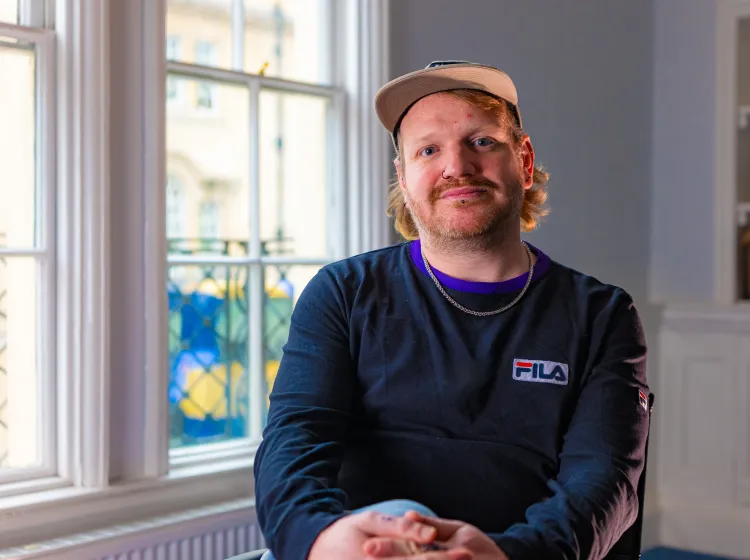
Simon Roche first became involved with Developing Health & Independence through our Criminal Justice Service. At the time, he was using ketamine heavily, experiencing homelessness and regularly coming into contact with the police. “Everything had got out of control,” he says. “Drugs were how I coped with what was going on around me.”
Simon started using cannabis aged 11. In his late teens he moved on to other substances, including ketamine. “When I didn’t want to think about anything , ketamine helped me switch off,” he says. Over time, his use increased until he was using it several times a week.
The impact on his life was severe. He spent around five years homeless, moving between the streets and hostels. “A low point was when I got kicked out of a hostel on Christmas Day for using drugs,” he says.
Simon’s mental and physical health declined as a result of ketamine. He experienced serious bladder and kidney problems, as well as periods of psychosis that led to hospital admissions. His relationships with family and friends broke down. “They started to see me as a liability,” he says.
As he became more isolated, his offending escalated. In 2023, he was arrested 11 times in four months and made several suicide attempts. “I didn’t think I’d live past 30,” he says.
But when Simon received a community order that included drug treatment through DHI, he saw the possibility of an alternative life. With support from the service, he entered rehab and later secured stable housing. “Getting help from DHI was the first time in years I felt properly listened to, not judged,” he says.
“When I met DHI Peers Christina and Jay, it was like I was at one end of a tunnel, and they were there with pickaxes at other end of that tunnel, chipping away until light shone through.”
DHI Peers are people with lived experience who are trained and supported to help others. Christina and Jay later went on to become support workers at DHI, showing Simon that paid employment was possible.
After starting his recovery journey, Simon became a peer supporter, using his lived experience to help others. He later became Peer Coordinator for DHI’s Criminal Justice Service in Bristol, helping to run groups and supporting clients one to one. “Being able to say, ‘I’ve been there’ makes a huge difference,” he says.
Simon is now employed by DHI as a Mental Health Treatment Requirements (MHTR) Practitioner. In this role, he supports people in the criminal justice system with practical interventions to manage their mental health, develop coping strategies and avoid custody where possible. “If I can help someone avoid the path I went down, that’s what matters,” he says.
The path ahead looks bright for Simon, who has found his passion in helping others. He is now planning to study counselling and therapeutic practice at university. “Recovery gave me a future,” he says. “I want other people to have that too.”
Get news from Developing Health & Independence in your inbox. See our privacy policy.